The architecture of predictability
- Robert Sosnowski

- 17 lut
- 3 minut(y) czytania
Zaktualizowano: 20 maj

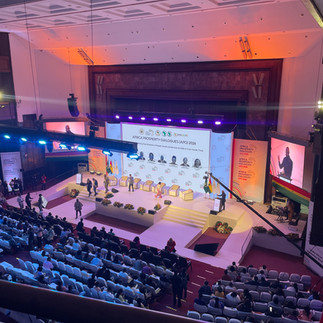
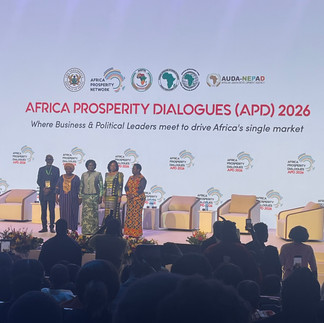
Notes from the Africa Prosperity Dialogues 2026 in Accra
Africa does not have a trade problem.
It has a first-transaction problem.
Goods exist. Capital exists. Entrepreneurs exist. Energy certainly exists.
What does not yet exist everywhere is predictable consequence.
At the Africa Prosperity Dialogues, one theme resurfaced across sessions that, on the surface, appeared unrelated: payments, mobility, SMEs, dispute resolution, financial infrastructure.
They were not separate discussions. They were components of one architecture.
More than once, the tone in the room shifted from applause to a direct call for implementation. The emphasis was no longer on well-framed commitments, but on timelines, enforcement and delivery.
A market does not begin with trade volume. It begins with enforceable expectation.
The most expensive part of an economy
Production exists. Demand exists. Local trade functions.
The difficulty begins when the parties do not know each other.
In many regions of the world, transaction costs fall with distance. Here, they rise with anonymity.
Not because people do not trust one another. But because there is no shared answer to a simple question:
what happens if something goes wrong?
Locally, the community provides that answer.Across borders, the institutional equivalent is still being built.
That is why the first transaction is the most expensive.
AfCFTA is not simply creating a market
AfCFTA is not primarily trying to increase trade. It is trying to create a situation in which trade feels normal.
Three elements repeatedly surfaced:
money must reach its destination,
people must be able to move,
and disputes must have a fast, binding resolution.
These are not logistical reforms.
They are an attempt to replace relationship-based certainty with institutional certainty.
Without dispute resolution, there is no market
Payment solves the beginning of a transaction. Mobility makes it possible to initiate one.
But only effective, cross-border dispute resolution closes the loop.
If an entrepreneur knows that, in case of conflict, there is a fast, recognised and enforceable decision, the risk of the first transaction falls dramatically.
Without that, integration remains declarative.
Markets are not built by declarations.
They are built by execution.
SMEs and the problem of economic memory
“SME” was one of the most frequently used terms.
The issue is not firm size. It is the absence of portable history.
A company may operate successfully within its local environment. Once it crosses a border, it effectively becomes unknown again.
AfCFTA is attempting to build a shared economic memory - one that functions beyond personal familiarity.
Payment is not technology
Payment systems appeared in nearly every session.
Not as fintech innovation. As a psychological condition.
A seller does not need to trust a buyer personally. They need to trust what will happen after shipment.
When the sequence of events is clear and reliable, markets emerge naturally.
Reputation as transitional infrastructure
The strongest reactions during the conference were not triggered by policy language, but by individuals whose personal credibility extended beyond the room.
This is not celebrity culture. It is transitional economics.
A recognised name reduces risk faster than a document.
Africa is not moving from relationships to institutions. It is attempting to build institutions that behave like relationships.
Fast consequence.
Memory.
Recognition.
Continuity.
What is actually being built
Not a common market in the classical sense.
What is being built is the possibility of cooperation without prior personal connection and without catastrophic downside risk.
The market will follow.
An economy truly begins the moment the outcome of a transaction no longer depends on who you know.
If this interpretation resonates - or diverges - I would value the perspective.











Robert Sosnowski is the founder of Growth Architects Studio. He has worked with 200+ brands across Europe and the US over 22 years in brand and growth strategy.
Conference recordings
For those interested in the broader context of the discussions:
Opening & strategic framing
https://www.youtube.com/watch?v=0rD8O9y6tjE
Official opening session outlining the AfCFTA framework and institutional direction of continental integration.
Full conference livestream – core discussions
https://www.youtube.com/watch?v=oL1j-x-SSEc
Complete stream covering payments, mobility, SMEs, dispute resolution, and implementation themes.
SME, finance & market infrastructure
https://www.youtube.com/watch?v=4AllpI9_lgU
Sessions focused on financing, value chains, and the infrastructure required for cross-border trade.
Business & institutional leadership
https://www.youtube.com/watch?v=42xOPvK0TU8
Strategic addresses by business and institutional leaders on execution and supranational mechanisms.
Closing & borderless Africa vision https://www.youtube.com/watch?v=9ghW0lRE7Gw Closing session framing integration as both an economic and institutional project.